
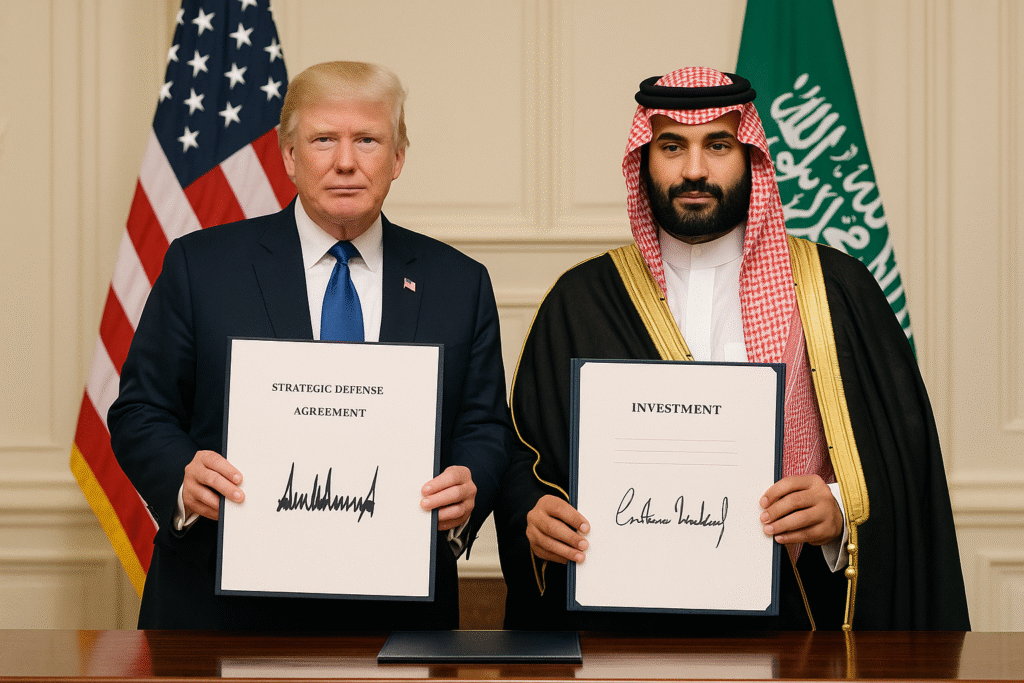
In a major geopolitical and economic development, U.S. President Donald Trump welcomed Saudi Crown Prince Mohammed bin Salman to the White House for a high-level bilateral meeting followed by a state dinner attended by global icons including Cristiano Ronaldo and Elon Musk. The visit marks one of the most significant U.S.–Saudi engagements in recent years, combining diplomacy, defense, and massive economic commitments.
A Strategic Defense Partnership for a New Era
During their Oval Office session, the two leaders signed a landmark Strategic Defense Agreement (SDA). Under this pact, Saudi Arabia is officially designated a major non-NATO ally, deepening military cooperation and enhancing long-term defense ties with Washington.
This status allows Saudi Arabia access to advanced U.S. weapons systems, joint military training programs, and enhanced intelligence sharing — signaling a powerful alliance in the evolving global security landscape.
Saudi Investments Near $1 Trillion: A Historic Economic Commitment
One of the most impactful announcements was Saudi Arabia’s plan to increase its investments in the United States to nearly $1 trillion.
This massive economic push will focus on high-growth sectors such as:
- Technology & Artificial Intelligence
- Infrastructure & Smart Cities
- Renewable Energy & Clean Technologies
- Defense Manufacturing & Innovation
- Startup ecosystems and venture capital
The investment wave is expected to accelerate job creation across U.S. industries and deepen commercial connections between American companies and Saudi Arabia’s Vision 2030 transformation strategy.
Tech Titans and Global Icons Attend State Dinner
The state dinner brought together some of the world’s most influential figures.
Notable attendees included:
- Cristiano Ronaldo, a global sports and investment personality
- Elon Musk, CEO of Tesla, SpaceX, and xAI
- Top U.S. CEOs, policymakers, and diplomats
- Saudi business leaders and sovereign fund executives
Their presence reflects the high-stakes economic potential at the heart of this partnership, especially in sectors like artificial intelligence, electric vehicles, space, and global entertainment.
Economic Impact on the United States
The nearly trillion-dollar investment initiative is expected to:
- Boost U.S. technology leadership
- Accelerate AI development through shared research programs
- Expand industrial manufacturing in states with growing workforce demand
- Strengthen energy partnerships, including renewables and hydrogen
- Drive private-sector collaborations with Saudi Arabia’s Public Investment Fund (PIF)
This commitment will likely reshape U.S.-Saudi trade flows and push both countries to the forefront of next-generation industries.
Why This Matters for the Global Market
This agreement is not just symbolic — it signals a shift in global alliances and investment patterns.
As Saudi Arabia diversifies away from oil and the U.S. aims to secure strategic partners in emerging technologies, this collaboration creates a mutually beneficial economic corridor.
For investors, companies, and global markets, the partnership may trigger:
- New cross-border investment opportunities
- Increased capital flow into U.S. tech and infrastructure
- Joint ventures in defense and energy
- Strengthened stability in the Middle East region
Conclusion
The Trump–MBS White House meeting marks one of the most influential diplomatic and economic events of the year. With a Strategic Defense Agreement, major non-NATO ally status, and nearly $1 trillion in Saudi investments, the U.S.–Saudi partnership is entering a new phase shaped by technology, security, and global economic growth.
This landmark deal is set to impact markets, industries, and geopolitical dynamics for the coming decade — making it a pivotal moment for businesses, investors, and policymakers worldwide.\
The information provided in this article is for general news and educational purposes only. While every effort has been made to ensure accuracy, details regarding political events, agreements, investments, and statements may evolve over time. This blog does not provide financial, political, or legal advice. Readers are encouraged to verify information independently and consult qualified professionals before making any decisions based on this content. The author and website are not responsible for any errors, omissions, or outcomes resulting from the use of this information.
Disclaimer: The information provided in this article is for general news and educational purposes only. While every effort has been made to ensure accuracy, details regarding political events, agreements, investments, and statements may evolve over time. This blog does not provide financial, political, or legal advice. Readers are encouraged to verify information independently and consult qualified professionals before making any decisions based on this content. The author and website are not responsible for any errors, omissions, or outcomes resulting from the use of this information.