
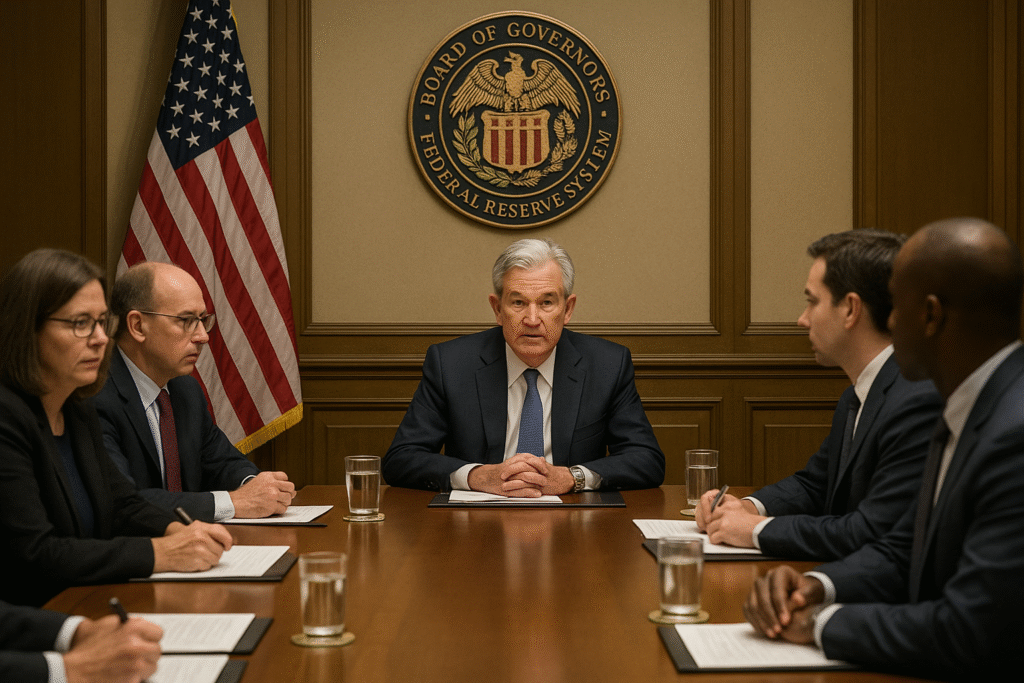
What Is the FED Meeting?
If you’ve ever seen headlines like “Markets on edge ahead of the Fed meeting” or “Fed raises interest rates again”, you’re hearing about one of the most powerful gatherings in global finance — the Federal Reserve (Fed) meeting.
In simple terms, the Fed meeting is where top U.S. central bankers decide how expensive or cheap borrowing money should be in America.
This one decision can ripple across the entire global economy — influencing home loans, stock markets, and even international currencies.
These meetings are officially called FOMC (Federal Open Market Committee) meetings, and they take place eight times a year — roughly every six weeks.
What Actually Happens Inside?
During the meeting, the Fed’s leaders — including the Chair (currently Jerome Powell) and other key members — discuss major economic conditions such as:
- How fast prices (inflation) are rising or falling
- How strong or weak the U.S. job market is
- What global risks might affect the U.S. economy
Then comes the big moment — they decide whether to raise, cut, or hold the interest rates.
- Rate Hike: Borrowing becomes expensive → Slows inflation
- Rate Cut: Borrowing becomes cheaper → Boosts spending and investment
This single decision can move global markets within minutes.
Unknown & Interesting Facts About Fed Meetings
1. The Meeting Minutes Are Like a Treasure Map
Three weeks after each meeting, the Fed releases detailed “minutes.”
Investors study every word, comma, and tone — trying to decode future actions.
It’s like reading between the lines of a secret economic diary.
2. There’s a Hidden “Dot Plot”
The Fed sometimes releases a chart called the Dot Plot, showing where each member believes future interest rates should be.
It looks simple, but this chart can move billions of dollars in global markets in seconds.
3. They Go into “Blackout Mode”
A week before every meeting, Fed officials stop giving interviews or speeches.
This “blackout period” ensures no insider information or market manipulation leaks before the decision.
4. Security Is Insanely Tight
Access during the meeting is extremely restricted.
Phones are off, notes are classified, and discussions are highly protected — as even a single leak could shake the entire world economy.
5. Markets React Before the Decision!
Believe it or not, traders often start reacting before the actual meeting — based on expectations, rumors, or even the tone of Jerome Powell’s previous statements.
Sometimes, the reaction itself is bigger than the decision!
6. Fed Language Is an Art Form
Every word in the post-meeting statement is carefully chosen.
A single word like “might” or “could” can send Wall Street into a frenzy.
Many say the Fed’s most powerful tool isn’t interest rates — it’s their vocabulary.
It’s Not Just About the U.S.
Because the U.S. dollar is the world’s reserve currency, every Fed decision affects global trade.
A single interest rate move can cause currencies in other nations to rise or fall, even if those countries had nothing to do with the meeting.